
By Katie Cook
And as imagination bodies forth
The forms of things unknown, the poet’s pen
Turns them to shapes and gives to airy nothing
A local habitation and a name. (V.i. 15-18)
These lines, spoken by Theseus in William Shakespeare’s A Midsummer Night’s Dream, are a description of the craft of poetry; the art of using figures of speech to express ideas or experiences that cannot adequately be expressed in direct language. Poetry, as with all art, is a product of the beautiful complexity of the human mind, and can foster empathy and understanding among the artist and the consumer. But these lines can also represent a much darker truth about the human experience: our tendency to create superficial divisions between ourselves and those who we deem “the other” in an effort to yield status and power. In other words, race is “A local habitation and a name” for an assumption about humanity that is essentially “airy nothing.” Poetry and racism – as absurd as it seems to connect the two – can both be boiled down to the manipulation of language: the former uses language to amplify the beauty of the human experience, and posit unity; the latter uses language to obfuscate the beauty of the human experience, and is inherently divisive. By nature, these two processes of language manipulation are incompatible, yet – when studying writers of color, such as Ann Plato – their intersection is inescapably present in the mind of the modern scholar.
In his introduction to the 1988 Oxford edition of Ann Plato’s Essays: Including biographies and Other Miscellaneous Pieces, in Prose and Poetry, Kenny Williams describes this interaction between our excessively-racialized modern gaze, and the study of historical black writers who do not fit into our narrative: “Because we have expected written records to display overt evidence not only of time and place but also of race and gender, we have become uncomfortable when they do not” (xl). Of course, I do not mean to suggest that nineteenth century America was not excessively-racialized – it was, to a significantly greater extent. But I
am emphasizing the fact that our modern gaze is still racialized, and manifests in a radically different way than the time period in which Ann Plato lived. Having said that – given the history of race relations in American culture – it would not be productive to ignore struggles or privileges that historical writers may have faced by virtue of their race. It is not the mere knowledge of Ann Plato’s race that prevents the modern scholar from taking her work seriously – it’s the way that knowledge is used to create unfair notions about what they believe she should have used her talents to write about. When analyzing Plato’s poetry, she should be given the same respect as Shakespeare, Emily Dickinson, Robert Frost, and so on. Simultaneously, the fact of her being of several demographics that are severely underrepresented in western literature should also be kept in mind. As Professor Antoinette Brim-Bell put it in her discussion with Natalie Belanger: “Some people change the dynamic and space of a room just by being in it. The fact that this young, indigenous, and black woman wrote a book changes our expectations of what other young people of color can do” (Belanger 20:39-20:58). With these things in mind, I will attempt to fairly analyze two of Ann Plato’s twenty poems: “Memory of Mary,” and “The Residence of My Father.” The reason I chose these two poems is because I believe they represent two vastly different and complex philosophies which can also be found in works by some of the most revered poets of all time. Individually, these poems exemplify Plato’s exceptional linguistic talents, and ability to grapple with existence and mortality on such a profound level. Together, these two poems exemplify the diversity of her thinking, and reveal her extraordinarily human uncertainty – bringing her down to Earth, in a way. I will begin by discussing “Memory of Mary”:
Thou wast simple in thy day,
Quiet in thy death,
And ere enur’d to childish play,
Yet now in ceasing breath. (5-8)
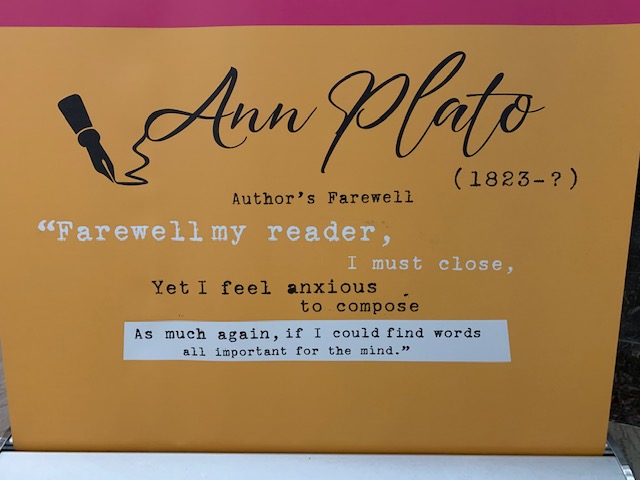
One might interpret this poem as a metaphor for virtue and innocence, as represented by the biblical Virgin Mary. This interpretation is qualified by James W.C. Pennington in his original introduction to Essays: “…it must be pleasing to the friends of youthful piety to see that religion is placed first” (xvii). And is further supported by the biblical nature of the proceeding lines:
“‘Suffer children unto me,’ / Is what our Saviour said” (9-10). Of course, the Virgin Mary would not have died as a child. However, by representing her as such, Plato is giving the reader the sense that this figure has not been subject to the complete human experience which is characterized by sin and suffering. Another interpretation – which I personally find more convincing – is that the Mary figure in this poem was an actual person in Plato’s life who died in her early childhood. The Stanza above, “Thou […] breath” (5-8), certainly alludes to the death of a young girl. What is striking about this poem is not that it references the death of a child, but that Plato reframes childhood death as a blessing rather than a tragedy. This is evident in the lines “Oh! how delightful that must be / How blest the early dead!” (11-12), and “Millions will wish their lives below, / Had been as short as thine!” (27-28). And the reason Plato believes early death is a blessing is because it frees us from the burdens of sin and suffering: “Ere sin might wound thy tender breast,/ Or sorrow cause a tear” (13-14).
Plato’s positive sentiment toward death as a “release from life” can be compared to the famous “To be, or not to be…” soliloquy from Shakespeare’s Hamlet:
… To die–to sleep,
No more; and by a sleep to say we end
The heart-ache and the thousand natural shocks
That flesh is heir to: ‘tis a consummation
Devoutly to be wish’d. (III.i. 5-9)
Of course, the context and nature of these two poems are totally different: Plato’s is, potentially, a tribute to a young girl in her life; Shakespeare’s is a fictional contemplation of suicide written for a tragic play. However, the philosophical matter of the selected lines from both Plato’s work and Shakespeare’s are undeniably similar. This shows that Plato has the capacity to think like Shakespeare, and the written skill to express those thoughts in a way that is just as effective; as Pennington put it: “She has done well by what nature has done for her, in trying what art will add” (xviii). Yet, one is revered as the greatest writer in modern English, and the other is – for all intents and purposes – lost to history. In stark contrast to “Memory of Mary,” Plato’s “The Residence of my Father” is a decadent appreciation for life which resolves into a somber acceptance of her inevitable death. I interpret the title as either referring to Plato’s actual childhood home, or the land on which the United States was built. It is possible that this poem is an appreciation for her indigenous roots -similar in nature to her poem “The Natives of America” – which she, of course, inherited from her Father. This is most evident in the following lines:
Heaven bless you, O ye groves,
Of which my father knows,
I thank you to ye sounding stream,
How oft you’ve woke the musing dream. (27-30)
The phrase “musing dream” is reminiscent of nineteenth century rhetoric which idealized American life (i.e. the “American Dream”). Of course, from the perspective of a part-indigenous woman, she channels this through her appreciation for the land itself.
Whether the title of this poem is an allegory for pre-American land, or a literal reference to her childhood home, it is undeniable that she is expressing a profound gratitude for life:
The morning lays are birds in song,
So often o’er the house they throng;
They perch upon the loftiest trees,
Where hum some very busy bees. (9-12)
Most of the poem is a romantic description of the world around her, going into meticulous detail about common scenes that most would take for granted. However, there is a notable tone shift as she transitions into the last stanza:
I soon may bid you all adieu,
For we cannot always stay,
And meet a scenery quite anew;
I’m sure to leave it, may be true,
And then we hasten and away:
Then may this Eden, beauty be
The same to stranger as to me. (33-39)
The poem ends with a melancholic recognition of her mortal condition, and therefore her cosmic insignificance. She will be gone, but this “Eden” will remain indefinitely. Once again, this poem can be compared to the work of William Shakespeare, whose “Sonnet 126” is also starkly contrasted with the monologue I discussed previously:
O thou, my lovely boy, who in thy pow’r
Dost hold time’s fickle glass his sickle hour,
Who hast by waning grown, and therein show’st
Thy lovers withering, as thy sweet self grow’st–
In nature, sovereign mistress over wrack,
As thou goest onwards still will pluck thee back,
She keeps thee to this purpose, that her skill
May time disgrace, and wretched minute kill.
Yet fear her, O thou minion of her pleasure;
She may detain but not still keep her treasure.
Her audit, though delayed, answered must be,
And her quietus is to render thee. (1-12)
This sonnet is a personification of nature – as Mother Nature – and her relationship with man. Specifically that she is given the pleasure of fostering humanity, but that pleasure comes at the cost of his inevitable aging and death. Of course, the concept of mortality – particularly that it is a somber event – is expressed in a significantly different way than it is in Plato’s poem. However, this is not because one poem is better than the other – they are simply different poets who conceptualize their own mortality in different ways.
Perhaps it is more appropriate to compare the work of Ann Plato to that of Emily Dickinson, as they lived around the same time, and in the same region of the same country, and they were both women. Dickinson’s famous 479th poem “Because I could not stop for death–” also deals with mortality:
Because I could not stop for Death –
He kindly stopped for me–
The Carriage held but just Ourselves–
And Immortality. (1-4)
Once again: a different poet writing about a different expression of a universal human experience, as it is conceptualized in a unique way. The point I am trying to make by bringing up these other writers is that – although we all, on some level, have experiences that are similar to those around us – we all live as unique individuals. And while not everybody has the capacity to understand or the skill to express their own experiences, there is no denying that Ann Plato does. So the question is not “why should we study Ann Plato?”, it’s “why shouldn’t we?” As Professor Brim-Bell said:
We have to remove our twenty-first century gaze from Ann Plato and her book, and I think we need to remove our expectations of what a black writer is supposed to be. […] There are a lot of ways to be black, a lot of ways to write black, a lot of ways to make a life for oneself in a landscape that is less than hospitable. (Belanger 35:18-35:59)
We read poetry to educate ourselves, enrich our lives, and reframe our own thinking. When we limit ourselves to one “kind” of human experience by deciding who can read or write about what, we are doing a disservice to ourselves. Ann Plato gave a profoundly human voice to young, black, indigenous women in the nineteenth century, and if we truly want to eradicate racism in the United States, we cannot afford to forget writers like her.
Works Cited
Belanger, Natalie. “‘Another Name for Happiness:’ The Life of Ann Plato.” Grating the Nutmeg, Ep. 134, Connecticut Explored, Jan. 15, 2022, https://gratingthenutmeg.libsyn.com/134-another-name-for-happiness-the-life-of-ann-plato.
Dickinson, Emily. “Because I Could Not Stop for Death – (479).” The Poems of Emily Dickinson. Ed. R.W. Franklin, Harvard University Press, 1999.
Plato, Ann. Essays; Including Biographies and Miscellaneous Pieces, in Prose and Poetry, 1841. University of Virginia Library,
https://xtf.lib.virginia.edu/xtf/view?docId=chadwyck_aap/uvaGenText/tei/chaap_D079.xml&chunk.id=d5&toc.id=d5&brand=default.
Pennington, James W.C. “To the Reader.” Essays, 1841. University of Virginia Library, https://xtf.lib.virginia.edu/xtf/view?docId=chadwyck_aap/uvaGenText/tei/chaap_D079.xml&chunk.id=d5&toc.id=d5&brand=default.
Shakespeare, William. A Midsummer Night’s Dream from The Folger Shakespeare. Ed. Barbara Mowat and Paul Werstine. Folger Shakespeare Library, 2016.
Shakespeare, William. Hamlet from The Folger Shakespeare. Ed. Barbara Mowat and Paul Werstine. Folger Shakespeare Library, 2012.
Shakespeare, William. “Sonnet 126: O thou, my lovely boy, who in thy pow’r.” Poetry Foundation, 2024.
https://www.poetryfoundation.org/poems/50649/sonnet-126-o-thou-my-lovely-boy-who-in-thy-powr.
Williams, Kenny J. “Introduction.” Essays; Including Biographies and Miscellaneous Pieces, in Prose and Poetry by Ann Plato, 1841. Oxford University Press, 1988.
Course: ENGL 1020
Assignment: Poetry Analysis
Instructor: Jeff Partridge
Instructor comments: Katie Cook’s essay exhibits an advanced college writer’s approach to the topic of Ann Plato’s poetry and her place in history. While reference to other poets was not a requirement, Katie took the initiative to make comparisons to writers she has studied in other courses. I like the way this essay build’s on Katie’s experience as a student of literature, transferring knowledge from one course to another. Katie also makes excellent use of secondary materials in both print and audio format, providing a critical context for evaluating Ann Plato’s place in history and value to us today.
Photo credit: Kevin Lamkins


Leave a Reply