
By Spencer Jahn
Wilfred Owen was an English soldier who fought for his country in World War I. During his service, he first wrote a draft of his famous poem Dulce Et Decorum Est somewhere between the fall of 1917 and 1918. He later revised this poem, and it was published posthumously after his death in November 1918. Dulce Et Decorum Est Pro patria mori comes from the poet Horace and is a Latin phrase meaning, “it is sweet and fitting to die for one’s country.” It is a firm anti-war poem. Within it, Owen utilizes the shocking and harrowing imagery of a first-hand point of view of a company of battle-weary men being ambushed by poison gas. His descriptions and prose are bleak, somber, anti-patriotic, and haunting and stand in stark contrast to the boisterous and pompous style of war propaganda that was common of the time, of subsequent wars after it, and even still is today. When reading this poem, you are taken to an indistinct muddy road in the middle of Europe with a gray and bleak sky overhead and smoke blackening the air around you.
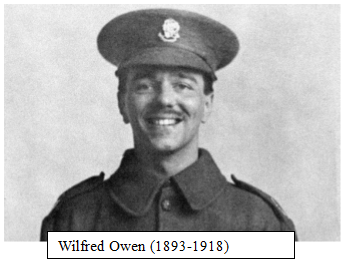
You can feel the cool and dampness of the day and can hear the sloshing and slodding of men’s boots and rustling clanking of equipment and uniforms as they march through the mud to reach their point of rest. You are left with a feelings of anger, sorrow, pity, and thankfulness upon reaching the end of his short work. Owen would not live to see the effects his work had on the literary world. He would be killed crossing the Sambre-Oise Canal just one week before the Armistice would be signed on November 11, 1918.
The brutality of war is told through the point of view of a common soldier in WWI (presumably Owen although it is easy to see the narrator as any man who served in the military in this conflict). Neither overly long nor too short, the story follows a group of beaten-down soldiers who are marching through Europe on their way to camp for some well-deserved rest. They are not a glorious group of heroes returning from completing tremendous acts of heroism but rather crippled, exhausted, hungry, and solemn. They are so weak and weary that they fail to see the beginning of a German attack behind them and realize all too late when some gas canisters land amongst them. The soldiers quickly arm themselves and don their protective gear but the narrator watches in horror as a man next to him succumbs to the gas. He does not die immediately from the attack but is instead loaded onto a cart and lies in agony as the survivors of the attack resume their march toward camp after it is resolved. The narrator is forced to march behind the cart where he must look at the man’s twisted face as the poison ravages his body. The story ends on a somber note remarking on how if those who did not serve were exposed to the true reality of war, they would not be so quick to glorify fighting and dying for one’s country to the younger and more impressionable generations. For anyone who has not read this poem, it is best described as an anti-war, anti-propaganda story. Its story is dark and depressing, but also unavoidably real. In the poem, the narrator struggles from a soldier’s perspective to relate the sights he seems to civilian life because war truly is incomprehensible to those who have not experienced it. In his best effort, he harkens the effects of the soldier mortality wounded by poison to someone dying from cancer.
“If you could hear, at every jolt, the blood
Come gargling from the froth-corrupted lungs,
Obscene as cancer, bitter as the cud
Of vile, incurable sores on innocent tongues” Here, Owen relates the horrors of war to more understandable terms to the average civilian. His ultimate question to the reader is: would you still tell a young boy this is a sweet and fitting way to die?
There are multiple images that Owen conjures to mind upon reading his work. The more prevalent one that people will most likely stick to is the image of the dying man’s face that Owen described as haunting him in his dream. However, the image that is the most important is the one of the events before this—the platoon of weakened and exhausted men marching back to their camp amongst the ruin of war around them. Although much more mundane on the surface, this image represents a much more common picture of war that does not rely on the grotesque and shocking to communicate how battle can wear on a person both mentally and physically. Additionally, it is an image that is in stark contrast to the clean-cut, spiffily-dressed, perfectly-uniformed soldier that dominates the war propaganda posters that Owen undoubtedly hated. The soldiers Owen describes are dirty. They are ragged and downtrodden. All they want is sleep (not glory). Their heads are down toward the ground, they are bloody and wounded, and most of them are missing pieces of their uniform like their shoes (has a shoeless soldier ever appeared in a military commercial?). It is because they are so disheveled that they fail to realize they are being attacked and why some of them are unable to put their helmets on in time to protect them from the gas. A well-rested and alert soldier would not have this problem. However, none of them are well-rested. This image immediately establishes the setting for the events that take place in the poem. Almost like a scene in a movie, through Owen’s description of the soldiers it’s like you are there walking amongst them before all hell breaks loose.
“And towards our distant rest began to trudge.
Men marched asleep. Many had lost their boots
But limped on, blood-shod. All went lame; all blind;
Drunk with fatigue; deaf even to the hoots
Of tired, outstripped Five-Nines that dropped behind.”
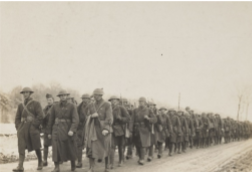
His choice to intricately describe how the soldiers were before they were attacked instead of just focusing on the shock of death like in other poems such as The Death of the Ball Turret Gunner shows there is more to be appalled by regarding the reality of war than just death. Everybody knows people die in a war, what they don’t realize is how much psychological and physical despair just being in an army can bring on a man.
Owen makes considerable use of rhyme to give his poem a rhythm throughout that carries it from beginning to conclusion. It was particularly interesting how he incorporated the rhyming scheme (consisting of every other line rhyming throughout) by breaking up the full phrase Dulce et Decorum est Pro patria mori into two separate lines to rhyme est with ‘zest’ from the line previous. His use of rhyming throughout does not induce a lightening of the mood of his words. His prose remains dark throughout, using words such as ‘haunting,’ ‘hags,’ ‘beggars,’ ‘sludge,’ ‘cud,’ ‘sin,’ and so forth. The choice of his diction offsets the flowy tempo that similar rhyming schemes imbue into their poems and thus create an air of levity or otherwise make whimsical sounding such as in poems like The Turtle by Ogden Nash. Because Owen’s material is so dark and grounded, he uses rhyme to keep tethered into the realm of poetry instead of just being a dramatical, non-fictional recounting of something he saw while on the front lines. Take this line for instance;
“If in some smothering dreams you too could pace
Behind the wagon that we flung him in,
And watch the white eyes writhing in his face,
His hanging face, like a devil’s sick of sin;
If you could hear, at every jolt, the blood
Come gargling from the froth-corrupted lungs,
Obscene as cancer, bitter as the cud”
Here, Owen uses a combination of his wording and rhyme scheme to make poetry out of something horrific like war and the somebody being injured by gas.
Reading through Owen’s poem elicits many feelings including those of sorrow and anger. The reader feels sorry for the soldier who was suffering from the effects of the poison but also for the narrator, who is clearly suffering from PTSD and other mental trauma from having to look at the face of someone dying from such a cruel weapon. On a grander scale, his writing elicits sadness for all soldiers who were involved in WWI, as there are obviously countless men who suffered fates like the ones depicted in the poem. Even worse so, there are countless men who never had their story told like Owen was able to do, and never will. You can’t help feeling anger at this Latin phrase which you never heard of before reading this poem, and reflecting on how many young ears it must have fallen on over the centuries, the minds its persuaded, and what became of those countless boys who believed in its sentiment. The poem evokes an ultimate feeling of reflection. The reader can’t help but wonder what they thought of war in the past or service to one’s country. It is easy to feel anger at the establishment, as we live in a society that sees men as so disposable. The consensus is that men are good for dying in war, but as far as understanding what they experience in war, people don’t actually want to know. This is why the draft has historically been limited to men, and why in modern conflicts like the one in Ukraine, women were allowed to evacuate the country when Russia invaded but all men were restricted from leaving and immediately used as fighters, even men as old as 60 and above. Owen’s message is one of reflection. He does not want pity for himself or his fellow soldiers but for us all to contemplate on how we view, approach, promote, and speak of war.
“If you could hear, at every jolt, the blood
Come gargling from the froth-corrupted lungs,
Obscene as cancer, bitter as the cud
Of vile, incurable sores on innocent tongues,
My friend, you would not tell with such high zest
To children ardent for some desperate glory,
The old Lie; Dulce et Decorum est
Pro patria mori.”
Owen’s ultimate story and message are simple and anyone can hear his cries against the wrongdoings he feels he has suffered from if they take the time to read through this poem even a few times. His message is not for young men eager to enlist in the military and protect their county. He is not trying to stop anyone from being unpatriotic. The real target audience is the average civilian who has never experienced a war. You can almost hear the Owen saying “take it from me” as you read the final lines of his poem. He is someone who has gone through the horrors of war and ultimately paid the greatest price. Even though death in war is a tragedy, this poem is not written to stop wars either. As stated earlier, it’s to reflect. It is a poem for everybody—man, woman, or child. It challenges to ask yourself what you really believe about serving your country and the cost it brings. People can most appreciate Owen’s writing when they chose to speak of war to younger children. How do we present it? Do we show them a Hollywood movie that is littered with “happy violence?” —(the “good guys” win, there is a main character who survives and returns to their family, or performs amazing acts of heroism and is revered, etc.) or do you share poems such as this one? The choice is one we can all make.
Works Cited
Wilfred Owen.” Rice N Peas, 20 Sept. 2010, https://ricenpeas.org/exposures/2017/7/7/wilfred-owen.
Baldwin, Aaliyah. Wilfred Owen and the Publication of Dulce Et Decorum Est. 5 Dec. 2021, https://editions.covecollective.org/content/wilfred-owen-and-publication-dulce-et-decorum-est.
Poets, Academy of American. “Dulce et Decorum Est by Wilfred Owen – Poems | Academy of American Poets.” Poets.Org, https://poets.org/poem/dulce-et-decorum-est. Accessed 6 Aug. 2024.
“LitCharts.” LitCharts, https://www.litcharts.com/poetry/wilfred-owen/dulce-et-decorum-est. Accessed 6 Aug. 2024.
Course: ENGL1020 Fall 2024
Assignment: Poetry Analysis
Instructor: Daniela Ragusa
Instructor comments:
Photo credit: Public domain


Leave a Reply