
By Linamaria Perez
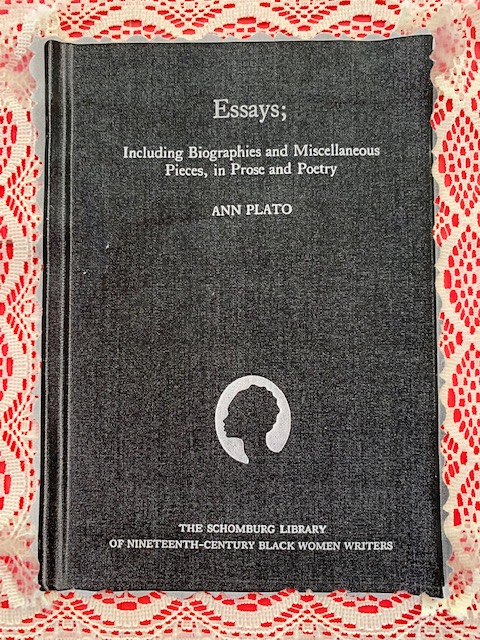
Ann Plato and Lydia Sigourney were two influential poets who lived and wrote in Hartford, Connecticut, during the 19th century. While Plato, an African American woman, remains lesser known today, Sigourney was widely published and celebrated in her time. Despite their differences in audience and recognition, their works offer rich insight into the social, racial, and moral concerns of their era. By examining Plato’s poetry alongside Sigourney’s, we not only uncover the complex intersections of race, gender, and morality in 19th-century American literature but also affirm the ongoing relevance of reading Plato’s work today.
Ann Plato was a Black poet and essayist born in Hartford, Connecticut, around 1820. As one of the first African American women to publish a book in the United States, she overcame significant barriers posed by her race and gender in a predominantly white literary world. Her sole collection, Essays; Including Biographies and Miscellaneous Pieces in Prose and Poetry (1841), reflects her deeply religious views and offers moral and social commentary from an African American perspective (Williams). Plato’s writing, influenced by her religious upbringing and the abolitionist movement, often emphasizes spirituality, morality, and the hardships faced by African Americans in a racially segregated society. Her poetry speaks in a marginalized voice, largely ignored by mainstream literary circles of her time.
Lydia Sigourney, by contrast, was born into a middle-class white family and gained widespread recognition for her literary achievements. Sigourney’s prolific career included dozens of volumes of poetry, prose, and essays, earning her the nickname “the sweet singer of Hartford” (Welburn). She often addressed themes of death, morality, and social reform, including education, women’s rights, and anti-slavery sentiments, though her advocacy was framed from a privileged perspective. Her polished, emotional style and frequent use of nature imagery made her work highly sentimental and widely appealing. Unlike Plato, Sigourney benefited from her social standing and access to established literary networks, enabling her to achieve significant public success.
In terms of themes, both Plato and Sigourney addressed issues of social justice and morality, yet their perspectives were shaped by their significantly different social positions. Plato’s poetry, for instance, often focuses on spirituality and morality. In her poem “Reflections,” she writes about the struggles and sufferings of life, urging her readers to find solace in faith and perseverance. Her deeply religious tone underscores her belief in moral fortitude and the promise of eventual justice. While Plato’s poetry does not explicitly explore the Black experience, some scholars, like Antoinette Brim-Bell, suggest that she subtly critiques racial inequalities by using religious language to avoid alienating her audience. This nuanced approach allowed her to address broader themes of injustice without directly confronting race in her works. (Brim-Bell)
Sigourney, on the other hand, wrote from the perspective of a white advocate for reform. Her poem “The African Mother at her Daughter’s Grave,” for example, reflects her abolitionist leanings by addressing the tragedy of slavery and the pain of separation. However, while she expressed sympathy for the plight of enslaved people, her work does not capture the lived experience of African Americans in the same way Plato does. Sigourney’s themes of death, morality, and social justice were framed within a broader context of moral reform, but from a distance that reflects her position in society (Williams). Her poetry calls for compassion and change, but it does so from the vantage point of privilege, lacking the deeper connection and firsthand perspective that would fully convey the impact of these issues on those affected.
In terms of tone and style, Plato’s writing is plain, sincere, and didactic. Her use of simple, direct language serves to convey moral lessons, often accompanied by a straightforward religious message. In Reflections, she writes, “Time is short, death is sure, / Sin is the cause, Christ is the cure” (Plato 27). While her style may lack the polish of Sigourney’s work, its clarity and directness give it a powerful moral force. Plato’s tone is earnest and unembellished, aimed at instructing her readers in spiritual and ethical matters.
Sigourney’s style, by contrast, is more polished and sentimental. She frequently employs nature imagery and emotional appeals to engage her readers. In her poem “The African Mother,” for instance, she uses rich, descriptive language to evoke the pain of a mother mourning her child: “The tearful dew on her cheek was frozen / As she bent o’er the grave of her only one” (Sigourney 102). While this approach is effective in evoking emotion, Sigourney’s sentimental tone often distances the reader from the harsher realities of the issues she addresses. Her work reflects the conventions of 19th-century women’s sentimental poetry, which frequently emphasized emotional responses to social issues without directly confronting the systems of oppression underlying them.
Scholars such as Antoinette Brim-Bell and Ron Welburn have discussed the racial and gender dynamics that influenced the careers of both Plato and Sigourney. Brim-Bell emphasizes the importance of recognizing Plato as a significant Black female voice in a white-dominated literary world (Brim-Bell). She argues that Plato’s work, while less celebrated, offers valuable insight into the spiritual and social concerns of African Americans in the 19th century. Brim-Bell argues that Ann Plato’s voice is distinct from Lydia Sigourney’s. Plato’s experiences as an African American woman gave her writing a unique perspective, particularly on race and education. Welburn and Kenny Williams also highlight the racial disparities in literary recognition between Plato and Sigourney, underscoring how Plato’s perspective was often marginalized in favor of more conventional white voices. (Williams)
Ann Plato’s poetry is a vital testament to the complexities of life in the 19th century, especially for those whose voices were often marginalized. Her work not only reflects African American experiences but also challenges the reader to confront the moral and social realities of her time. In a world where black women writers were rarely recognized, Plato’s poetry insists on being seen and heard, making its rediscovery an act of historical correction. Her poems resonate with contemporary debates about race, gender, and spirituality, offering timeless reflections that speak to current struggles for justice and equality. By reading Plato alongside Lydia Sigourney, we can appreciate a broader spectrum of American literature, embracing both dominant and marginalized voices. This pairing enriches our understanding of the complexities of 19th-century poetry, revealing how different perspectives, when read together, can offer profound insights into the human condition across time.
Works Cited
Brim-Bell, Antoinette. “Another Name for Happiness: The Life of Ann Plato.” Podcast of Connecticut History: Grating the Nutmeg, Connecticut Explored Magazine, 22 Jan. 2022, Accessed Oct. 2024.
Gura, Philip F. “A Woman’s Work: Ann Plato’s Republic.” Society for U.S. Intellectual History, 8 Dec. 2016, https://s-usih.org/2016/12/a-womans-work-ann-platos-republic/.
“Lydia Huntley Sigourney | Poetry Foundation.” Poetry Foundation, 2020, www.poetryfoundation.org/poets/lydia-huntley-sigourney.
Pennington, James W.C. Introduction. Essays: Including Biographies and Miscellaneous Pieces in Prose and Poetry, by Ann Plato, 1841, pp. 1-5.
Williams, Kenny J. Introduction to Schomburg Edition of Ann Plato’s Book. Schomburg Center for Research in Black Culture, New York Public Library, 1986.
Course: ENGL1020 Fall 2024
Assignment: Poetry Analysis
Instructor: Jeff Partridge
Instructor comments: I selected Linamaria’s essay for submission to Capital Letters not only as an excellent example of essay structure, cohesion, and incorporation of research, but also for what it says about two Hartford writers, one a celebrated poet with a Hartford street named after her, and the other a groundbreaking Black writer forgotten both in her era and today. Linamaria says it best: “In a world where black women writers were rarely recognized, [Ann] Plato’s poetry insists on being seen and heard, making its rediscovery an act of historical correction.”
Photo credit: Kevin Lamkins


Leave a Reply