By Nathanial Gardner
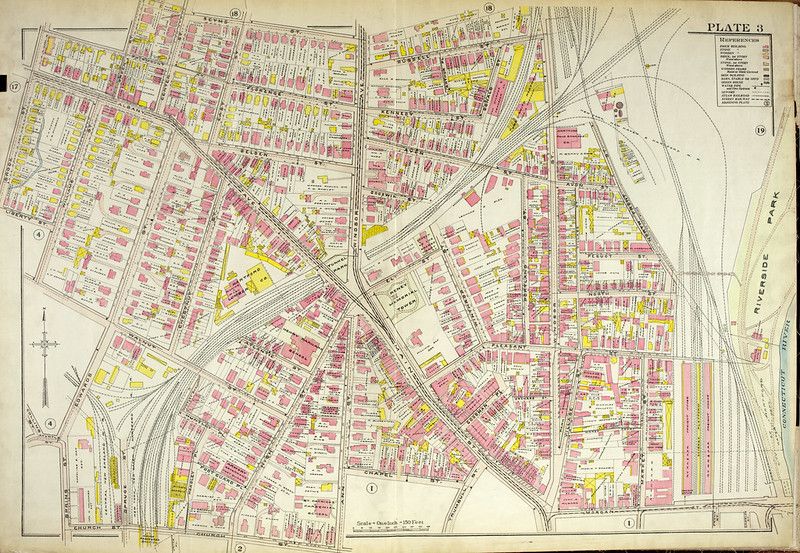
The play Take a Giant Step, written by Louis Peterson, is a powerful and hidden gem set in the city of Hartford, Connecticut. One of the main topics that the play touches on is “place.” A quote by Edward Casey states, “There is no place without self and no self without place” (Casey). This play is a testimony to Casey’s quote. The connection between identity and place is heavily incorporated in this play and shown through a series of events. This motif of place takes on deeper resonance when we consider the historical and geographical setting of the play.
The main character of this play is Spence. Spence is one of four Black people in his high school and the only Black family within the south end. A central tension is introduced at the beginning of the play when Spence gets kicked out of school. This event is what the play is centered around and is carried throughout the play. Spence is suspended from school because, while his White female teacher is teaching a history lesson, she makes fun of “negroes” and as a result, Spence stands up to the teacher, calling her a “moron” and saying her class is “crummy” (Peterson 14). This event’s fallout is reflected by the clash between him and his friend group and family, which makes Spence evaluate himself.
The idea of place continues to drive the tensions as the play progresses. This is seen when Spence decides to travel to a bar after his suspension to achieve a sense of self. It is important to consider he goes to a bar on the opposite side of town in the north end, which is predominantly Black. His traveling represents his feeling of misplacement in the south end. He travels to the North end in hopes of finding a place where he is understood and valued. Spence even goes to a woman’s house from the bar, seeking validation of his manhood. Through his journey in the North End, Spence experiences a multitude of difficult emotions which build onto the initial tension.
After spending time at the bar, he still felt out of place in the north end and decided to return home to explain himself to his parents, hoping his parents would see that he is the victim of injustice and would understand why he confronted his teacher. Unfortunately, his expectations were not met. His parents expressed that Spence should not have opposed his teachers and his actions were disrespectful. Spence’s father says, “We do things we don’t like to do every day of our lives. I hear those crumbs at the bank talk about niggers and making jokes about niggers every day—and I stay on—because I need the job” (Peterson 59). This quote clearly shows how a specific place alters how an individual interacts. This also reveals how an individual can be willing to sacrifice their dignity or self-respect because of the importance a place has to them. In this case, Lem’s workplace is important to him, so his tolerance for racist remarks in that place is different.
A critical contrast can be drawn between Spence’s reaction to racist remarks and how his family reacts to racist remarks. Spence is rebellious, unapologetic, and raw in his reaction to racist remarks; whereas his parents, May and Lem, are more conserved, patient, and give deference to White people. These contrasting responses to racism form a message about the divergence of mental place between Spence and his parents. The time difference and environment these characters have grown in can be attributed to these differing mindsets. May and Lem take on a more obedient role which can be connected to their older generational upbringing, where they were told that in order to succeed, you have to obey your “superiors.” Spence has a more hopeful approach due to growing up in a younger generation where equality did not seem as unattainable.
Later in the play, this divergence builds conflict between Spence and his mother, which furthers the tension of the play. A heated argument forms that reveals their opposing perceptions of “place” as a Black person in America. Spence’s mother introduces another notion of “place” to inform him of his rebellion against his said “place.” She states, “You are a little colored boy–not to realize what you are–and you have no business talking back to white women, no matter what they say or what they do. If you were in the South, you could be lynched for that…So from now on, my advice to you is to try and remember your place” (Peterson 59-6). This quote plays a very pivotal role in Spence’s journey of finding his “place.” Throughout the play, Spencer is very strong-minded in his opinion that he is not going to give deference to White people, but now confronted with his parents’ perspective that, it is his “place” to give deference, it creates a new view within the story. This confrontation with his mother poses a question: would Spence succumb to the systemic racially biased norms in order to live the American life or continue to stand for the equality he believed in? Spence would have to later answer this question himself.
This quote also is the first time the South is used as contrast from the North. This quote exemplifies how the motif of place not only forwards the tensions in the play but introduces the geographic context of the play to the audience. Geographic context is a significant factor of the play that adds dimension to the story. An example is New England’s contextual background at the play’s time (circa 1950). When looking back at history, it is commonly assumed that New England was always a free and liberating area for everyone. We can validate this by looking at when Christine describes her past life before moving to New England from Alabama, saying “No I didn’t like it much down there…I wanted something better, I guess. I decided I was coming up North to try my luck” (Peterson 72-3). This image was not always accurate. As an audience member consuming this text within the context of Christine’s story of finding placement, a new layer of understanding is added to the story. New England did not compare to the violent and harsh atmosphere of the South, but it was not entirely free or liberal in terms of discrimination. In a book titled, On the Line, Jack Dougherty writes about the redlining that occurred during the 1930s and 40s in Hartford. Dougherty states, “In the housing sector, the color line gained more governmental support…with federal and local policies that openly prohibited home mortgages and public housing for blacks, and legally protected white-only property deeds” (Dougherty and Contributors). This blatant discrimination was deeply embedded and affected the racial demographics of towns in Connecticut, proving this New England utopia to be false. Redlining is just one of the many examples of discrimination throughout the history of Connecticut and other New England states. The geographic context is built upon the motif of place and helps readers achieve a complete scope of view of the story.
The play’s historical context also possesses a level of significance in the creation of the play. The history and geographic setting of the play is deeply connected to the writer, Louis Peterson, and the town of Hartford. The play is a raw representation of the place of Hartford and its past. When researching the background of Louis Peterson, you can draw many connections to the character Spence and Louis. Peterson states that the story’s setting is a New England town (Peterson 7). However, we can conclude that this is Hartford from context clues like Christine referring to the insurance company ad and how Hartford’s is known for being the “insurance capital of the world”, Louis Peterson’s history living in Hartford as a youth, and the history of redlining in Hartford in relation to the racial and economic division between the north end and south end present in Spence’s hometown. From these clues we can form a strong theory that this play was based on Peterson’s experience, in his home town Hartford. Also, looking back at Louis Peterson’s high school yearbook, there are only three other Black students within his graduating class. Other sources like Louis Peterson’s census information and online citizen data maps reveal that only five Black people lived in the town Louis Peterson lived in, according to the 1940 U.S. Census. We can assume that these five Black people were the Peterson family. Therefore by contextualizing the text we gain another perspective of Louis Peterson who has intimately experienced this discrimination and living within a segregated community. Louis Peterson’s experiencing this first hand allowed him able to capture in his story that New England was not a perfect place for Black people and that the feeling of misplacement was common. Peterson confronts his audience with the racism of the North which brings significant power to the play. This context is important when considering the motif of place because it brings deeper meaning to the play. Without context, we cannot appreciate the story’s full meaning. The purpose of the context and motif of place is to create meaningful, deeper connections in the play.
Take a Giant Step forms a unique and important message about the significance of place which is seen in the characters’ personalities, physical settings, geographic context, plot elements, and more. Despite the book being based in the past, its connection to place is still very prevalent and to the Hartford of 2023. After contextualizing and putting the play in conversation with the writer’s background, we see that the story of Take a Giant Step is pivotal to the history of Hartford and establishes an essential message about the impacts of place.
Works Cited
Casey, Edward S. “Between Geography and Philosophy: What Does It Mean to Be in the Place-World?” Annals of the Association of American Geographers, vol. 91, no. 4, 2001, pp. 683–93. JSTOR, http://www.jstor.org/stable/3651229. Accessed 21 Feb. 2023.
Dougherty, Jack, and And Contributors. “On the Line: How Schooling, Housing, and Civil Rights Shaped Hartford and Its Suburbs.” Chapter 2 Segregating Along Color Lines, 22 Jan. 2023, https://ontheline.trincoll.edu/segregating.html.
“United States Census, 1940,” database with images, FamilySearch (https://familysearch.org/ark:/61903/1:1:KWMP-DNM : 13 May 2020), Louis S Peterson in household of Louis S Peterson, Ward 7, Hartford, Hartford Town, Hartford, Connecticut, United States; citing enumeration district (ED) 10-89, sheet 6B, line 43, family 109, Sixteenth Census of the United States, 1940, NARA digital publication T627. Records of the Bureau of the Census, 1790 – 2007, RG 29. Washington, D.C.: National Archives and Records Administration, 2012, roll 536.
Peterson, Louis. Take a Giant Step: A Drama in Two Acts. S. French, 1982.
Course: ENG 102
Assignment: Text and context essay
Instructor: Jeff Partridge
Instructor comments: One quality that I appreciate in all of Nate Gardner’s assignments is his patience with his subject. This essay on Hartford-born Louis Peterson’s play Take a Giant Step is an strong example of that quality. Nate develops his discussion of place as a motif in the play in a variety of ways and never seems to be moving on too soon. His essay gets more and more nuanced as he goes along. Another quality I admire in Nate is his willingness to take a piece of writing through numerous drafts, incorporating teacher and peer feedback to improve the essay, and working on it until he is satisfied with the result. This essay went through that process and improved every time.
Photo Credit: UConn Library MAGIC (Creative Commons)
 Capital Letters
Leave a comment