By Jason Soucie
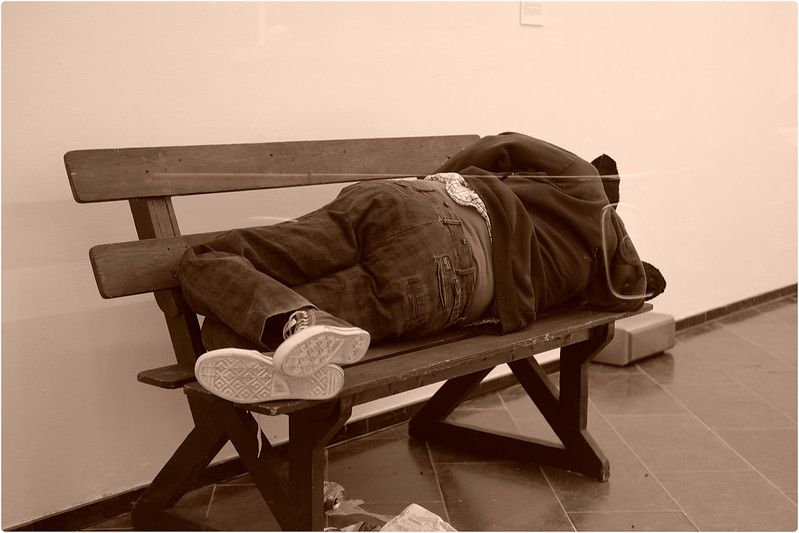
Homelessness and poverty are arguably two of the biggest problems facing today’s college-age youth. With the price of living drastically increasing within the last three years, many students have fallen on hard times. Education can not only be used as a ticket to a better life, but it can also allow students to utilize campus resources to help stabilize their living situations. Colleges and universities alike should have easily accessible resources readily available for all students who require assistance both mentally and physically, regardless of their financial standings. By access to free education, programs such as mentoring/counseling, financial aid, and education, can drastically reduce the rate of homelessness and economic insecurity in college students.
Both small colleges and large universities pride themselves on being easily accessible to students of all backgrounds, regardless of culture, ethnicity, socioeconomic status, or ability. Common programs such as, financial aid, tutors, clubs and support groups, mental health counselors, dining and housing programs, and mentors/advisors are just a few examples of how students can get assistance directly from their respective college. According to authors Syeda Razia Bukhari, Haroon-Ur-Rashid and Syeda Ishrat Fatima of the article, “Prevalence of Depression Among University Students with Reference of Demographic Factors,” “It is the most critical time for students’ life. They try to sustain good academic grades to get best jobs for their future and to maintain economic stability for their family and remains away most of the time from their homes which causes anxiety. It produces lot of stress and ultimately leads towards depression in many students”, (Bukhari et. al, 2017). With college being the time where most individuals find their own path, the pressure of that alone can be taxing, adding poverty and homelessness in the mix can lead to catastrophic and unforgiving consequences. Providing programs to help college students is not an uncommon practice in most colleges and universities, however, many students remain unaware that said programs exist. Without the proper marketing on campuses to spread awareness that help is available, many of these programs become severely underutilized. Resources to fund these programs for certain student are also at risk. Mark Kantrowitz, author of “With Performance-based Funding, the Neediest Students Lose,” writes “The failure of government grants to keep pace with increases in college costs on a per-student, inflation-adjusted basis shifts more of the burden of paying for college from the federal and state government to students and their families. This leads to shifts in enrollment patterns (e.g., from four-year to two-year colleges) that contribute to declines in bachelor’s-degree attainment by low-income students” (Kantrowitz, 2016). With lack of funding, coupled with competitive aid-recipients, low-income students get the short end of the stick. Colleges should make a point for assistance programs of all kinds readily accessible for students regardless of socioeconomic status or circumstance.
Creating programs to help homeless and impoverished college students works on paper, however, with competitive funding, lack of knowledge and information, and low enrollment numbers, students can often be unaware that relief if just around the corner. There are many common misconceptions about student poverty and homelessness. Outsiders often think, ‘why can’t they just save money?’, ‘it’s their own fault’, or ‘just find a job’. However, most college students who face these conditions can come from broken or abusive homes, suffer from mental health issues, or have been victim to unlucky financial situations. Kelly Field, author of “How to Help The Students Who Have No Homes,” gives an example of a young college student named Christine Banjo, who has faced poverty since she was a young girl, “Ms. Banjo says she tries not to dwell on her status but “to put it in a box and act like a normal person.” She avoids calling her parents because she doesn’t like to be reminded that they’re still struggling. Her father works as a valet at a hotel, but her mother is schizophrenic and can’t work. The challenges that homeless students face extend well beyond shelter to food insecurity, sleep deprivation, and poor health. Many must choose between educational expenses and meals, according to Feeding America, a national network of food banks”, (Field, 2015). By aiding students such as Christine Banjo, not only is her education being helped, but her mental and physical health is more likely to increase the more these programs are utilized, leading her to a better quality of life. Kara Yorio, author of “In Plain Sight,” also tells the heart wrenching story of Dylan Chidick, another homeless college student. “’I was embarrassed,’ he says. ‘I didn’t want anybody to know. There’s such a stigma around the word homelessness. You hear that, and people change the way they think about you. So, I hid it.'” Chidick is not unique in keeping that fact to himself. One of the biggest challenges facing educators trying to support homeless students is knowing that they are homeless: “‘It’s super underreported,’ says Susan Austin, superintendent of schools for a district covering North Berwick, Berwick, and Lebanon, ME (serving about 3,200 students), and the district’s homeless liaison. ‘It’s one of those things that people don’t talk about a lot, but it’s everywhere. I’ve seen it in every community. It doesn’t matter what the socioeconomics are. It’s just one of those things that is hidden, a right-in-front-of-your-face hidden thing'” (Yorio, 2019). Chidick and Banjo are just two examples of homeless students who struggled to survive daily. By lifting others up and getting these programs into the hands of more college students, we can all strive for a brighter future.
Educational institutions for higher learning have been around for hundreds of years; however, it is only within the last 75 years that college has been becoming increasingly more accessible for people across all walks of life; not solely reserved for the elite. In order to help break the educational gap between upper and lower class, free community college has been implemented in over 14 states across the US, with more states scheduled to follow suit in the years to come. If all 50 states enact easy access to free education, then the US population can expect poverty and homelessness in youth to decrease significantly. According to Eric Kelderman, author of Plans for Free Community College Meet Resistance in Several States, “the focus on community colleges has grown in recent years, thanks in part to President Obama, who in 2009 challenged two-year colleges to create five million more graduates by 2020. While the $12 billion the president sought for community colleges never fully materialized, the expectations for more degrees remained”, (Kelderman, 2014). States that face high poverty levels, such as Mississippi, West Virginia, New Mexico, and Alabama, are attempting to enact free community college so that students who are currently facing poverty and homelessness can break the cycle for future posterity. “In the wake of the recent economic downturn, state lawmakers have focused on the job-creating potential of community colleges, a concept bolstered by data from Georgetown University’s Center on Education and the Workforce showing that a majority of future employment opportunities will require the kind of degrees and training most commonly offered by community colleges. And because they are generally more affordable and perceived as less liberal than four-year colleges, community colleges have a bipartisan appeal, said Stephen G. Katsinas, director of the Educational Policy Center at the University of Alabama at Tuscaloosa”, (Kelderman, 2014). As stated prior, 14 US states currently offer free community college for first time students, which means that 14 states are allocating resources, time, and energy into uplifting students who come from broken backgrounds, and may be struggling to survive. This proves that not only is the plan for free community college feasible, it’s also very realistic; legislatures in most states are following suit.
Implementing accessible college programs for students facing homelessness and poverty initially comes across as a crowd pleaser, however, there are those who are against the idea. It is not because they do not want students to receive the help they need; it is because of the trickle-down factors that come into play when local colleges are open for all. Aspects such as a decrease in applications and low diversity rates from larger universities are two main examples of what the effects of free education could lead to. Those who fall into this group of naysayers are mostly comprised of people within the upper class of society who can afford college with little, or no aid required. Free education could potentially threaten to make private universities less diverse and sought after due to community colleges being low cost or free. This trickle-down could alter funding and graduation rates for these flagship universities. Jamal Abdul-Alim, author of Free College Proposal a Threat to Private Colleges, Diversity, Some Say, addresses the point, “The reason, the analysis states, is because such institutions have “potentially unlimited enrollment because everyone who applies is accepted.” It also stems from the fact that students who cannot afford private colleges and do not qualify for more selective public universities would “have no choice but to go to open-access institutions if they want to go to college,” and there would be a “cascading effect as students who could not get admitted to more selective flagship and mid-tier public universities choose to go to open-access institutions”, (Abdul-Alim, 2016). Even though there is potentially a shift in applications to larger universities, upper class individuals who can afford college should look at the positives, which drastically outweigh the negatives. By opening the doors to education for all parties, there is a more than likely rate that diversity rates in flagship colleges can increase overtime, rather than decrease. According to Catherine Morris, author of the article, Momentum Matters for Community College Transfer Students, studies have shown that transfer rates from community colleges to four-year universities have increased within the last 10 years by 14%, (Catherine Morris, 2016). By accepting more transfer students into larger universities, colleges can see an increase in student diversity from students of all background who gained enough credits and confidence to comfortably enroll in four-year universities to obtain bachelors, masters, and possibly doctorates. Without access to free education, students who fall below the poverty line would not have a chance to go on to higher learning environments. Mindfulness, Openness to Diversity, and Color-Blind Racial ideology Among White Undergraduate Students, by Stacy Vance, Shengli Dong, and Dania Tawfiq found in their research, “Colleges in the United States are becoming more diverse. Increased diversity on campuses of predominately White institutions have benefits of enhancing cultural awareness and pluralistic orientation and reducing discrimination and prejudicial attitudes,” (Vance et. al, 2022). This can create campuses that thrive on diversity, tolerance, acceptance, and open-mindedness. Even though the upper-class naysayers find issue with free education, the lasting affects it can have on society, present and future, are priceless.
If all 50 states implemented free community college, making all resources and opportunities available, struggling students would be able to have access to higher education, mental and physical assistance, guidance, and a strong sense of community. If free community college become reality in all 50 states, the gap between those suffering from poverty and homelessness v. middle and upper class will begin to close. With this essay, I am hoping to convince those who are against free community college, such as upper-class individuals or large flagship universities, out of fear that it will severely disrupt their own lives/institution. The results of free community college are overwhelmingly positive, lower poverty, lower homelessness among students, giving impoverished students mental and physical assistance, and more opportunities for better jobs. It is my hope that readers of this essay can spread the word that free community college across all 50 states is an absolute necessity; we must push lawmakers to pass free education bills.
Allowing access to a better life should not be solely reserved for the wealthy and elite, education access should be like food and water, a necessity that everyone should have in order to survive.
Work Cited
Abdul-Alim, Jamaal. “Free college proposal a threat to private colleges, diversity, some say.” Diverse Issues in Higher Education, vol. 33, no. 18, 6 Oct. 2016, pp. 6+. Gale Academic OneFile, link.gale.com/apps/doc/A467058257/AONE?u=22506&sid=bookmark-AONE&xid=39ef6985. Accessed 7 Jan. 2023.
Avery, Christopher, et al. “Policies and Payoffs to Addressing America’s College Graduation Deficit.” Brookings Papers on Economic Activity, fall 2019, pp. 93+. Gale Academic OneFile, link.gale.com/apps/doc/A635738179/AONE?u=22506&sid=bookmark-AONE&xid=24e4f0aa. Accessed 6 Jan. 2023.
Bukhari, Syeda Razia, et al. “PREVALENCE OF DEPRESSION AMONG UNIVERSITY STUDENTS WITH REFERENCE TO DEMOGRAPHIC FACTORS.” Pakistan Journal of Clinical Psychology, vol. 16, no. 1, 30 June 2017, p. 61. Gale Academic OneFile,
link.gale.com/apps/doc/A697427990/AONE?u=22506&sid=bookmark-AONE&xid=2d393660. Accessed 7 Jan. 2023.
Field, Kelly. “How to help the students who have no homes.” The Chronicle of Higher Education, vol. 62, no. 1, 4 Sept. 2015, pp. A8+. Gale Academic OneFile, link.gale.com/apps/doc/A428997139/AONE?u=22506&sid=bookmark-AONE&xid=c65ba18d. Accessed 7 Jan. 2023.
Kantrowitz, Mark. “With performance-based funding, the neediest students lose.” The Chronicle of Higher Education, vol. 62, no. 32, 22 Apr. 2016, pp. A33+. Gale Academic OneFile, link.gale.com/apps/doc/A452051453/AONE?u=22506&sid=bookmark-AONE&xid=24b1237c. Accessed 7 Jan. 2023.
Kelderman, Eric. “Plans for Free Community College Meet Resistance in Several States.” The Chronicle of Higher Education, vol. 60, no. 28, 28 Mar. 2014. Gale Academic OneFile, link.gale.com/apps/doc/A364442681/AONE?u=22506&sid=bookmark-AONE&xid=b2386bc5. Accessed 8 Jan. 2023.
Morris, Catherine. “Study says ‘Momentum Matters’ for community college transfer students.” Diverse Issues in Higher Education, vol. 33, no. 1, 11 Feb. 2016, p. 8. Gale Academic OneFile, link.gale.com/apps/doc/A444712162/AONE?u=22506&sid=bookmark-AONE&xid=b9f845ed. Accessed 7 Jan. 2023.
Vance, Stacy, et al. “MINDFULNESS, OPENNESS TO DIVERSITY, AND COLOR-BLIND RACIAL IDEOLOGY AMONG WHITE UNDERGRADUATE STUDENTS.” College Student Journal, vol. 56, no. 2, summer 2022, pp. 119+. Gale Academic OneFile, link.gale.com/apps/doc/A714069807/AONE?u=22506&sid=bookmark-AONE&xid=e3ca953e. Accessed 7 Jan. 2023.
Yorio, Kara. “In PLAIN SIGHT.” School Library Journal, vol. 65, no. 7, Aug. 2019, pp. 24+. Gale Academic OneFile, link.gale.com/apps/doc/A596317651/AONE?u=22506&sid=bookmark-AONE&xid=30131f9e. Accessed 7 Jan. 2023.
Course: ENG 101
Assignment: Research Argument
Instructor: Daniela Ragusa
Photo Credit: “Homeless” by pvl83 (Creative Commons)
 Capital Letters
Leave a comment